

Information
Rainwater Harvesting in the UK: What the New SuDS Standards Mean for Developers, Self-Builders and Homeowners
The way we think about water in the UK is changing. With increasing pressure on water resources, concerns around surface water flooding and a growing need for more sustainable homes, rainwater is increasingly being recognised as a valuable resource rather than something that simply needs to be drained away.
The Government’s updated National Standards for Sustainable Drainage Systems (SuDS), published in June 2025 and updated in July 2025, reflect this changing approach.
For housebuilders, property developers, self-builders and homeowners planning improvements to their properties, rainwater harvesting is becoming an increasingly important consideration.
But what has actually changed, why are traditional water butts no longer considered sufficient in certain circumstances, and how could rainwater harvesting benefit your next project?
What are the new SuDS standards?
Sustainable Drainage Systems (SuDS) are designed to manage surface water in a way that more closely mimics natural drainage processes.
Rather than simply directing rainfall into drainage networks, SuDS aim to manage water closer to where it falls, helping to reduce surface water runoff, manage flood risk, improve water quality and support biodiversity.
The updated national standards introduce a clearer framework for how surface water should be managed within new developments in England.
One of the most significant changes is the emphasis on treating rainwater as a resource that can be collected and reused, rather than simply discharged elsewhere.
Rainwater harvesting is now Priority 1
Under Standard 1 of the updated SuDS guidance, the Government has introduced a hierarchy for where surface water runoff should be directed.
The five priorities are:
- Collected for non-potable use.
- Infiltrated into the ground.
- Discharged to an above-ground surface water body.
- Discharged to a surface water sewer or other piped drainage system.
- Discharged to a combined sewer.
Collecting rainwater for non-potable use sits at the very top of this hierarchy.
This is an important development for the rainwater harvesting industry. It demonstrates the growing recognition of water reuse within sustainable drainage design and encourages developers to consider rainwater harvesting at an early stage of their projects.
The guidance also states that rainwater harvesting must be considered where there is a demand for non-potable water and a suitable catchment area, where landscape irrigation is required, or where a development is located in an area identified as seriously water stressed.
Are traditional water butts still enough?
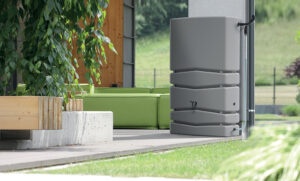
Water butts remain a useful and accessible way for homeowners to collect rainwater for their gardens. However, the updated guidance makes an important distinction between basic rainwater storage and a properly designed rainwater harvesting system.
Under Standard 2, developments must manage the first 5mm of rainfall for the majority of rainfall events, helping to prevent unnecessary runoff.
The guidance recognises rainwater harvesting systems designed to BS EN 16941 as a suitable approach to meeting these interception requirements, provided they are based on regular daily demand for non-potable water.
It also makes clear that traditional water butts restricted to garden use during dry periods are not considered sufficient to demonstrate compliance.
Why? Because a water butt may remain full between periods of use, meaning there is no guarantee that storage capacity will be available when the next rainfall event occurs.
A properly designed rainwater harvesting system works differently. By supplying regular non-potable water demands, such as toilet flushing or garden irrigation, it can create ongoing storage capacity for incoming rainfall.
This is why system design and the intended use of collected water are so important.
What does this mean for housebuilders and property developers?
For housebuilders and developers, the updated guidance provides an important reason to consider rainwater harvesting much earlier in the development process.
Planning the system from the outset allows developers to consider roof catchment areas, tank positioning, storage capacity, pipework and non-potable water demand alongside the wider drainage strategy.
Rainwater harvesting can be incorporated into individual properties or considered as part of a wider development, depending on the project’s requirements.
With water efficiency becoming an increasingly important consideration in residential construction, developers have an opportunity to deliver homes that make better use of available rainfall and reduce reliance on treated mains water for suitable applications.
Getting specialist advice early can also help ensure that the right solution is considered before layouts and infrastructure are finalised.
Building your own home? Think about rainwater harvesting from the beginning.
Self-builders have a particularly good opportunity to incorporate rainwater harvesting into their plans.
When designing a new home, it is often easier to consider rainwater harvesting before construction begins, rather than trying to retrofit a system later.
Roof design, tank location, plumbing arrangements and the intended uses of collected water can all be considered alongside the wider building design.
A domestic rainwater harvesting system can supply suitable non-potable applications such as toilet flushing and garden irrigation, helping households make better use of the rainfall collected from their roofs.
For anyone planning a self-build, it’s worth discussing rainwater harvesting with your architect, designer or building professional at an early stage.
Renovating or extending your home? Could you make better use of rainwater?
Rainwater harvesting isn’t just for new-build properties.
Homeowners undertaking renovations, extensions or significant garden improvements may also find it a good opportunity to explore rainwater harvesting.
Although the updated national SuDS standards are primarily intended for new infrastructure and development, rather than directly applying to retrofit projects, they can provide a useful starting point when considering improvements to existing properties.
Depending on the property and available space, a rainwater harvesting system could provide water for garden irrigation or be incorporated into suitable non-potable plumbing arrangements.
If you’re already undertaking building work, it may be worth considering whether rainwater harvesting could be incorporated into your plans.
It’s often easier to explore the possibilities while other improvements are already underway.
Looking ahead: making every drop count
The UK’s approach to managing water is evolving, and rainwater harvesting has an increasingly important role to play.
From large-scale residential developments to individual self-build projects and home improvements, there are opportunities to make better use of rainfall and reduce reliance on mains water.
The updated SuDS standards are an important step in recognising the value of rainwater, but the benefits of harvesting and reusing water extend well beyond regulatory requirements.
Whether you’re planning a development, building your own home or considering improvements to your property, now is a good time to explore what’s possible.

Thinking about rainwater harvesting for your next project?
Get in touch with Rainwater Harvesting Ltd. Our team would be delighted to discuss your requirements and help you find the right solution.
About Author